
Procurement
Global IT Hardware Procurement: How to Source Servers and GPUs Without Killing Your Timeline
Global Hardware Procurement Challenges
Procurement looks like a transactional function. You pick the vendor, place the order, and wait for the hardware to arrive. In practice, every procurement decision has downstream consequences that show up at integration, deployment, or operational handoff. A wrong configuration choice means re-work. An optimistic lead time creates schedule risk. A single-vendor commitment limits flexibility when supply chains tighten.
Hardware procurement for global infrastructure is genuinely difficult work. GPU markets are constrained. Multi-vendor mixes require coordination across OEMs with different ordering processes. Regional availability varies. Lead time information from vendors is often optimistic. The procurement team that consistently delivers infrastructure on schedule is the procurement team that takes the work seriously.
This post covers how to scope hardware procurement for global deployments, the most common procurement failures, and what good multi-vendor sourcing looks like in practice.
The downstream cost of procurement mistakes
Three categories of procurement mistakes consistently hurt deployments.
Configuration errors
The wrong RAM density, the wrong drive form factor, missing rail kits, incompatible PSU options. Configuration errors are caught at integration time, when the racks are being built. Returning incorrect components and waiting for correct replacements adds weeks to the schedule. Worse, configuration errors discovered after shipment require returns from the destination country, which adds international logistics complexity.
Lead time misses
The vendor commits to 8 weeks. The actual delivery takes 14. The integration timeline assumed 8. Now the deployment is 6 weeks late. Lead time misses are particularly damaging for AI infrastructure right now, where GPU SKUs sometimes carry 20+ week lead times and frequently slip.
Vendor concentration
Sole-sourcing critical components with one vendor creates risk when that vendor cannot deliver. Diversifying procurement across vendors requires more relationship management but provides resilience when supply chains tighten.
What good procurement scoping looks like
Procurement scoping happens before the purchase orders are placed. The work involves translating workload requirements into specific configurations, validating compatibility, and building in lead time risk management. Good scoping covers:
• Workload requirements translated into specific compute, memory, storage, and network sizing
• Vendor options evaluated across performance, price, and lead time
• Configuration validation against integration design
• Alternative SKUs identified for components with supply risk
• Regional availability assessed for destination markets
• Total landed cost analyzed including duties, taxes, and logistics
• Vendor lead times benchmarked against historical performance, not vendor commitments
This is more work than most procurement processes do. The companies that do it consistently deliver infrastructure on schedule. The companies that skip it deal with reactive problem-solving throughout the project.
Multi-vendor sourcing in practice
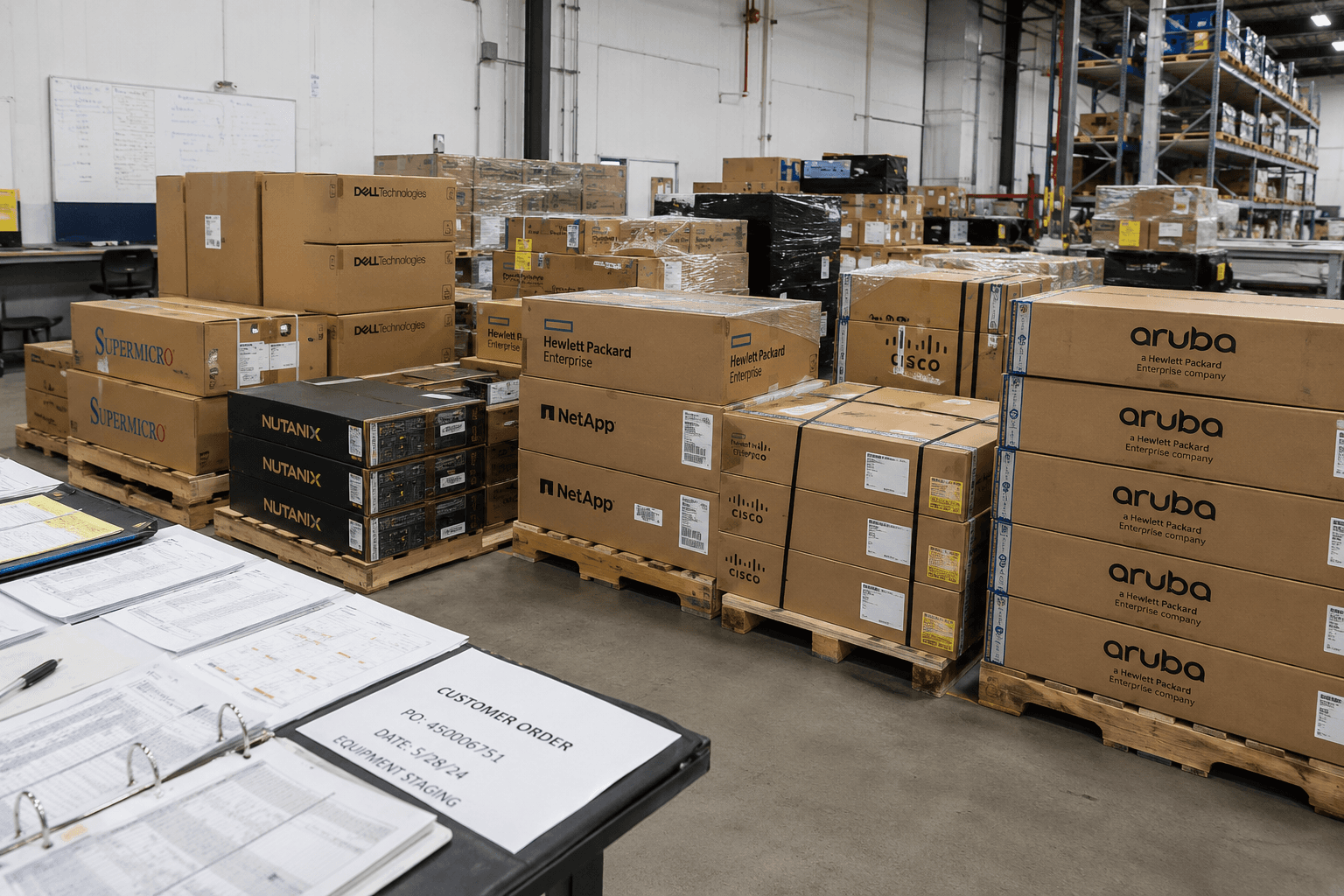
Most enterprise infrastructure builds combine hardware from multiple OEMs. Dell servers paired with Arista switches paired with NVIDIA GPUs paired with NetApp storage. Multi-vendor sourcing is the norm, not the exception.
Coordinating procurement across vendors creates real overhead. Each vendor has its own quoting process, ordering system, support model, and warranty terms. Each vendor's lead times move independently. Consolidating purchase orders across vendors into one delivery timeline requires active management.
Procurement partners who maintain relationships with major OEMs and consolidate the work into one engagement remove the coordination burden. The customer sees a single proposal, places a single PO, and gets a single project manager coordinating across vendors.
GPU procurement deserves its own section
GPU markets have been supply-constrained for two years and continue to be. NVIDIA H100 and H200 lead times remain long. New SKUs face allocation processes that favor large hyperscaler customers. Enterprises looking to deploy AI infrastructure compete for capacity in a market where vendor relationships matter.
Effective GPU procurement requires:
• Early engagement with vendor allocation teams
• Realistic lead time expectations based on current market conditions
• Alternative SKU planning when primary choices are constrained
• Integration considerations like power, cooling, and rack density built into the procurement scope
• Coordination with deployment timelines so GPU arrival aligns with site readiness
Buying GPUs late, in small quantities, or without vendor relationships is a recipe for schedule slip. Buying them through a procurement partner with established vendor relationships and current market intelligence is dramatically more reliable.
Regional sourcing considerations
Where hardware is sourced affects total landed cost, lead time, and IOR complexity. The default of sourcing from the US and shipping globally is often not the lowest-cost or fastest option. Regional sourcing strategies depend on:
• Vendor pricing variation across regions
• Local stock availability with regional distributors
• Duty and VAT implications of source country vs destination country
• Lead time differences between regional vendor distribution centers
• Trade agreements that affect duties on cross-border movement
For a deployment in Singapore, sourcing through APAC vendor distribution can be faster and cheaper than shipping from US stock. For a deployment in Brazil, local sourcing through Brazilian distributors avoids significant import complexity even when the unit price is higher.
Consolidated invoicing and commercial terms
Multi-vendor procurement creates accounts payable complexity. Six vendors, six invoices, six payment cycles, six contract negotiations. Procurement partners that consolidate vendor relationships into one commercial agreement and one invoice simplify the back office work and often deliver better aggregate pricing through volume.
Negotiated commercial terms with a procurement partner can include consolidated payment terms, escrow arrangements for advance payments, and unified warranty coordination across vendors. These are operationally meaningful, not just convenience features.
How Global Edge approaches hardware procurement
Global Edge maintains multi-vendor relationships across the major data center OEMs and ODMs. We provide procurement scoping that translates workload requirements into validated configurations, secure pricing across vendors, monitor lead times against historical performance, and coordinate consolidated delivery.
For AI workloads, our engineering team validates GPU and networking selections against deployment design before procurement, reducing the risk of configuration mismatches at integration. For multi-country deployments, our procurement scope integrates with IOR and logistics planning so total landed cost is visible at the proposal stage.
Next steps
Procurement decisions for the next deployment cycle should be in motion now if hardware is needed in the next two quarters. Send us the bill of materials or workload requirements and we will return pricing, lead times, and a procurement scope within 48 hours.