
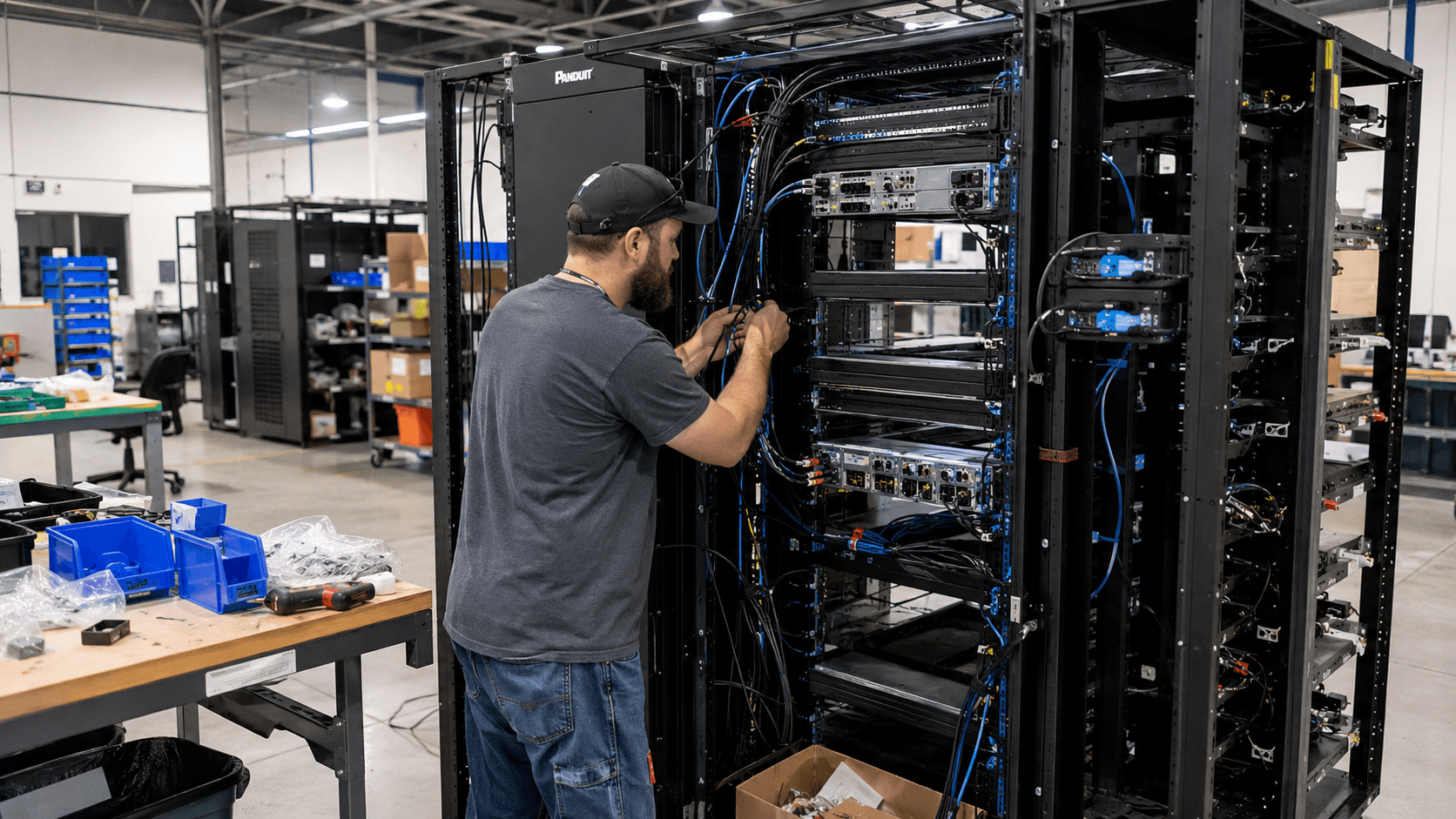
Integrated Racks
Integrated Rack Solutions: How Pre-Built Racks Cut Deployment Time by Weeks
Most enterprise data center deployments still follow the same playbook from a decade ago. Hardware ships from multiple OEMs to a destination facility, then a field team assembles racks on site, runs cabling, validates configurations, and discovers integration problems the hard way. The model works, but it is slow, expensive, and unpredictable.
Integrated rack solutions flip the sequence. Components are sourced, assembled, cabled, tested, and packaged in a controlled integration facility before shipment. The destination team receives a complete rack that needs to be unpacked, anchored, powered on, and connected to the network. The result is a deployment process that is faster, more consistent, and far easier to scale across multiple sites.
This post explains how integrated rack solutions work, what makes the difference between a good integration partner and a bad one, and the scenarios where the model genuinely outperforms field integration.
What is an integrated rack solution?
An integrated rack solution is a complete, pre-configured server rack assembled to customer specification in an integration facility and shipped production-ready. The integrator handles component procurement, mechanical assembly, structured cabling, asset labeling, configuration management, burn-in testing under load, and packaging for transit. The customer receives a documented, validated, ready-to-deploy unit.
The work is the same work that would happen in your data center anyway. The difference is where and when it happens. Doing it in a purpose-built facility, with dedicated integration engineers and controlled conditions, produces better outcomes than doing it on a noisy data hall floor under time pressure.
The hidden costs of field integration
Field integration looks cheaper on paper because the integration labor is bundled into broader deployment scope. The real cost shows up in three places.
First, field labor is more expensive than facility labor. A senior data center technician on site costs more per hour than the same skill set in an integration facility, and they often cannot work as efficiently in the destination environment.
Second, integration problems discovered in the field cause schedule slips. A wrong component, a defective part, or a configuration error caught at install time means hardware needs to be returned, replaced, or worked around. Each issue cascades into deployment delay.
Third, multi-site deployments suffer from inconsistency. Field teams in different regions produce subtly different builds. Cable management varies, labeling conventions drift, and configuration baselines are hard to enforce. The result is an infrastructure estate that looks consistent on paper but operates differently site to site.
What good rack integration looks like
Not all integration providers deliver the same quality. The differentiators are visible in four areas:
• Configuration management. Every rack has a documented bill of materials, cabling diagram, labeling scheme, and configuration baseline. The integrator captures changes during build and provides full as-built documentation at handoff.
• Burn-in testing. Quality integrators run racks under simulated production load for a defined period, monitoring for thermal, power, and component failures. Catching a bad component during burn-in is much cheaper than discovering it after deployment.
• Packaging engineering. Custom-designed packaging built for international transit, including shock and tilt indicators, climate control, and rack-specific bracing. Cheap packaging causes shipping damage that erases the integration benefit.
• Documentation. Photo documentation of the build, signed quality checklists, configuration baselines, and chain-of-custody records. Without these, you have a rack but not a deployable asset.
When integrated racks make the most sense
Three scenarios consistently justify integrated rack delivery over field integration.
Multi-site deployments
If you are deploying the same rack design across 10, 50, or 500 sites, integrated delivery enforces consistency that field teams cannot match. Every rack arrives identical. Configuration drift across sites becomes the integrator's problem to prevent, not the operations team's problem to fix.
AI and high-density workloads
GPU clusters and liquid-cooled racks require precise assembly and validation. Field environments are a bad place to discover that a GPU did not seat properly or that liquid cooling lines were not torqued to spec. Integrated facilities can run high-density racks through proper validation before shipping.
Time-critical launches
When the destination facility is on the critical path, integration that happens in parallel with site preparation collapses the schedule. Hardware arrives the day the data center is ready. No integration window is needed before go-live.
Questions to ask an integration partner
Before committing to an integration engagement, get clear answers on these:
• What burn-in test profile do you run, and what failure rate do you typically catch?
• How is configuration drift prevented across multiple racks built to the same spec?
• What documentation is delivered with each rack, and in what format?
• How is packaging engineered for the destination country?
• What is your process when a defective component is discovered during build?
• Can you ship internationally with IOR coverage, or do I source that separately?
The last question matters more than most buyers realize. An integration partner who cannot manage international logistics forces you to coordinate IOR, customs, and inbound logistics separately. That creates the exact handoff risk integration was supposed to remove.
How Global Edge approaches rack integration
Global Edge runs integrated rack solutions as a single accountable engagement. Component sourcing, assembly, cabling, burn-in testing, packaging, and global delivery are handled by one team with one project manager. We coordinate with our IOR and logistics teams so racks ship through customs and arrive on-site without separate vendor handoffs.
For multi-site deployments, we provide configuration baselines and photo documentation per rack so your operations team can verify what was delivered against what was specified. For AI and high-density workloads, our engineering team validates power, cooling, and component compatibility before build begins.
Next steps
If you are planning a rack deployment of more than ten units, or any multi-country build, integrated delivery is worth scoping. Send us your rack design or current bill of materials and we will return an integration proposal within 48 hours.